Bank Brand Implementation: The Strategic Rollout Guide for GCC and MENA Banks

Filed Under Blog
Bank brand implementation: a strategic rollout guide for marketing managers, CMOs and transformation leads at GCC and MENA banks. Let’s get right to it.
Ask any bank marketer who has lived through a rebrand what they remember most. It is rarely the reveal. It is the morning after.
The chequebook reorder nobody scoped. The ATM screens sitting behind a vendor’s fourteen-week queue. The tower sign that cleared the board in March and the municipality in… well, nobody is quite sure yet. The Arabic fascia that came back from the fabricator in the wrong weight, on the one branch the Chairman drives past every morning.
Here is the curious part. The brand that wins the boardroom is often not the brand that reaches the customer. Somewhere between approval and rollout a perfectly good idea is diluted, delayed or quietly abandoned. The cause is almost never creative. It is implementation.
So what separates a bank rebrand that lands from one that limps? In a word: foresight. In eight words: the disciplines below, applied before anything is designed.
In short: bank brand implementation is the planned rollout of a new or revised bank brand across every touchpoint (branches, digital channels, cards, ATMs, documents, uniforms and internal culture) in a sequence the business can absorb, the regulator will approve and the customer will actually notice.
Why a bank rebrand is a transformation, not a design job
A bank brand transformation succeeds when the agency has already implemented banking brands, because the hard problems only reveal themselves in rollout. Designing a bank identity is a few months of work. Landing it across a branch estate, a core banking platform, a card portfolio and two languages typically takes nine to eighteen months.
A bank is not a consumer brand with a vault. It answers to a central bank, often a Sharia board, a compliance function, a risk committee and a board of directors, all before a single customer sees anything. Its brand is delivered by thousands of people, through hundreds of touchpoints, many of them owned by third parties: card schemes, ATM manufacturers, signage fabricators, core banking vendors and print suppliers.
That is why the best agency for bank brands is not simply the one with the most beautiful identity in its portfolio. It is the one that has carried a banking brand from the boardroom to the branch floor and knows where the bodies are buried (usually in the procurement schedule).
At Unisono we have spent more than two decades doing exactly that from our base in Manama, on financial brands including Khaleeji, Bank Muscat, GFH and Mala’a. If you are still at the shortlisting stage, our companion piece How to Choose a Branding Agency for a Bank covers selection. This article picks up where that one ends: what a strategic approach to bank brand implementation looks like once the work begins.
The eight disciplines of a strategic bank rebrand rollout
A strategic approach treats the rollout as a programme to be designed, with the same rigour as the identity itself. In practice that means eight disciplines, each agreed before the creative work is signed off. Skip one and it will find you later, usually at the most expensive moment.
1. Strategic vision: for the project, the launch and beyond
A bank rebrand needs three visions, not one. The project vision defines what success means for the board. The launch vision defines what customers, staff and media should feel on day one. The long-term vision defines what the brand must still be doing in five years, when the launch campaign is a distant memory and the brand is being stewarded by people who were not in the room.
In practice this means a C-suite workshop that ends with a single written statement of intent, signed off by the CEO and referred back to at every gate. When a debate stalls over a shade of green on the app icon, the vision settles it. Without one, the loudest voice does.
2. Auditing and discovery: find the real issues first
Every bank believes it knows its own touchpoints. Very few do. A proper discovery audit catalogues every place the brand lives (physical, digital, printed, spoken and contractual), identifies who owns each one and flags the dependencies nobody mentioned in the brief.
This is where the real issues surface: the legacy subsidiary brand nobody wants to own, the merger heritage still printed on the branch safe-deposit keys, the mobile app whose design system cannot accept a new typeface without a release cycle. Discovery also listens to customers and staff, because their perception is the baseline every result will be measured against.
3. Stakeholder alignment: from the CEO to the print suppliers
Stakeholder alignment is the single biggest predictor of rollout success. Brands fail in the approval room far more often than in the studio and they fail on the shop floor more often still.
A strategic agency maps every stakeholder group with a role in delivery: the board, the CEO, business unit heads, the Sharia board, compliance, IT, HR, branch managers, facilities and, crucially, the external suppliers who will physically produce the brand. Each group gets the briefing it needs, at the moment it needs it. The print supplier who understands why the Arabic must match the Latin optically will protect your brand. The one who has only seen a PDF will ‘fix’ it.
4. Team chemistry: make sure agency and client gel
A bank rebrand is a long relationship conducted under pressure. Twelve to eighteen months of weekly meetings, late approvals and occasional crises is a test of character as much as competence.
Chemistry is not a soft extra. It is the difference between a team that raises a problem on Sunday morning and a team that hides it until Thursday. Before committing, meet the people who will actually do the work (not just the people who pitched it), agree how disagreements will be escalated and decide who chairs the hard conversations. The best agency for bank brands will welcome that scrutiny, because it has been through enough rollouts to know what happens without it.
5. Programme planning: scope every touchpoint in a viable matrix
The touchpoint matrix is the backbone of bank brand implementation. It lists every branded item, then scores each one by customer visibility, cost, lead time, regulatory sensitivity and dependency on other items.
The matrix turns an overwhelming inventory into a sequenced plan. High-visibility, low-dependency items (the app icon, the website, the social channels) can move fast. High-cost, long-lead items (tower signage, ATM fleets, card reissue) are phased against natural replacement cycles so the bank is not paying to destroy perfectly good stock. Everything gets an owner, a budget line and a date.
6. Timing: a roadmap that fits the bank’s essential milestones
A bank does not pause for a rebrand. The roadmap must work around results announcements, AGMs, regulatory filings, Ramadan and Eid trading patterns, product launches, core banking migrations and, in the case of a merger, legal day one.
A reasonable roadmap is built backwards from the immovable dates, then pressure-tested against supplier lead times. If the launch date is political (and it often is) the plan must say plainly what can be ready by then and what will follow in a managed second wave. An honest roadmap delivered on time beats an ambitious one delivered in fragments.
7. In-house talent: the availability of your marcom team
The most underestimated constraint in any bank rebrand is the client’s own team. Your marketing and communications colleagues will be asked to approve, brief, coordinate and launch the new brand while still running campaigns, sponsorships, annual reports and the daily flood of requests from the business.
A strategic agency plans for that reality. It asks early who is available, for how many hours a week and with what authority. It identifies where its own team should carry the load (brand management, supplier briefing, quality control) and where your people must lead (internal engagement, regulator relations, executive approvals). It also trains your team to own the brand after launch, because the agency should not be the only one who knows how it works.
8. Testing assumptions: leave nothing to chance
Every plan rests on assumptions and every untested assumption is a future change request. Will the new colour reproduce on the card manufacturer’s plastic? Does the logo hold at 16 pixels in the app tab bar? Does the Arabic tagline carry the intended meaning across Gulf dialects? Will the municipality permit an illuminated sign of that size?
Testing means prototypes, physical mock-ups, pilot branches, customer research and supplier trials before the full rollout is committed. It is far cheaper to discover a problem on one branch than on sixty.
Foresight is the work
Alan Kay said it to a room of planners who were busy forecasting what technology would do next. His point was that the future is not something you wait for; it is something you design. A bank rebrand rollout works the same way. The problems on launch day are entirely predictable. The only question is whether someone predicted them, on paper, months earlier, while they were still cheap to solve.
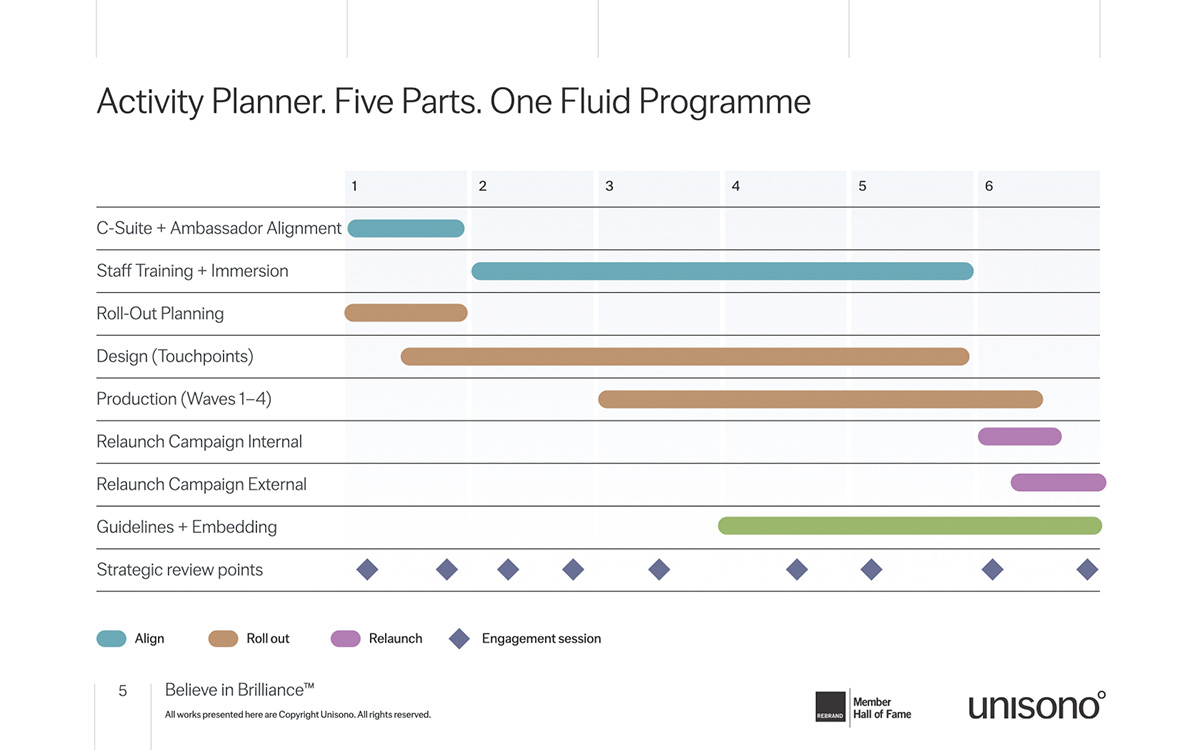
Once you have leased with your banking client on their key milestones, planning the work is the essential next step. The implementation plan for each work phase is essential.
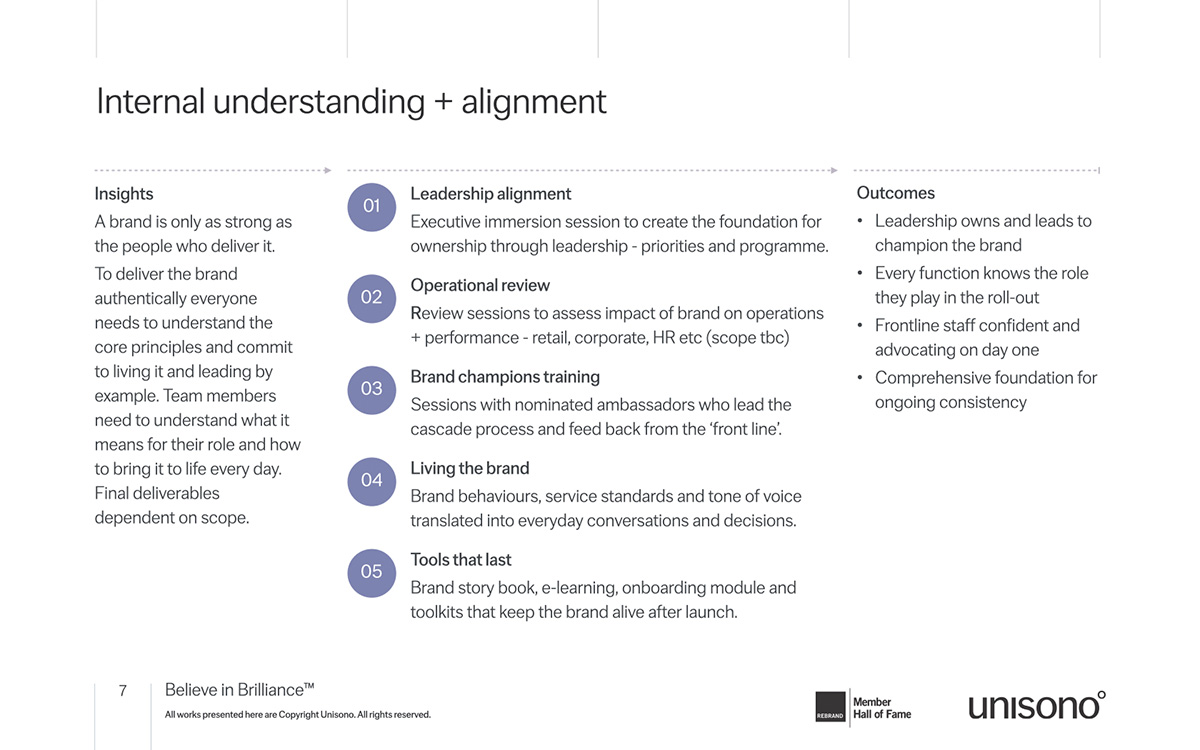
Alignment of the stakeholders doesn’t happen by magic but it feels like magic when it happened. Once everyone is aligned to the task ahead the project work streams can flow.
The rollout readiness checklist: does your agency understand what’s coming?
Use these questions in a chemistry meeting or alongside your RFP. An experienced brand agency for banks will answer most of them without notes and will probably add a few you had not thought of. If an agency can confidently answer fewer than twelve, you are about to pay for its education.
Vision & discovery
- Can they describe how they would define success for the project, the launch and the five years after it?
- Will their discovery audit cover physical, digital, printed and contractual touchpoints, including subsidiaries and legacy brands?
- Do they ask about your core banking platform, app release cycle and card reissue schedule in the first meeting?
Stakeholders and team
- Can they name the approval stages a bank brand must pass in your market (central bank, Sharia board, compliance, legal)?
- Do they have a plan for briefing branch staff, contact centre teams and frontline employees before customers see the brand?
- Will they brief and quality-check your external suppliers (signage, print, card, ATM) directly?
- Are the people who will do the work the same people in the pitch room?
Planning and timing
- Will they build a touchpoint matrix that scores every item by visibility, cost, lead time and dependency?
- Does their roadmap work backwards from your fixed dates: results, AGM, Ramadan, product launches, migrations?
- Can they explain how they would phase high-cost items against natural replacement cycles to protect budget?
- Have they asked how many hours your marcom team can realistically give each week?
Testing and handover
- Will they prototype and pilot (cards, signage, app screens, a pilot branch) before full rollout?
- Is Arabic treated as a design discipline from day one, tested across dialects, not translated at the end?
- Will they deliver brand management tools, governance and training so your team can run the brand after launch?
- Can they show you a banking brand they implemented three or more years ago that still looks consistent today?
If the answers come back specific, grounded in named projects and slightly uncomfortable to hear, you have probably found the best agency for bank brands for your rollout. If they come back as adjectives, keep looking.
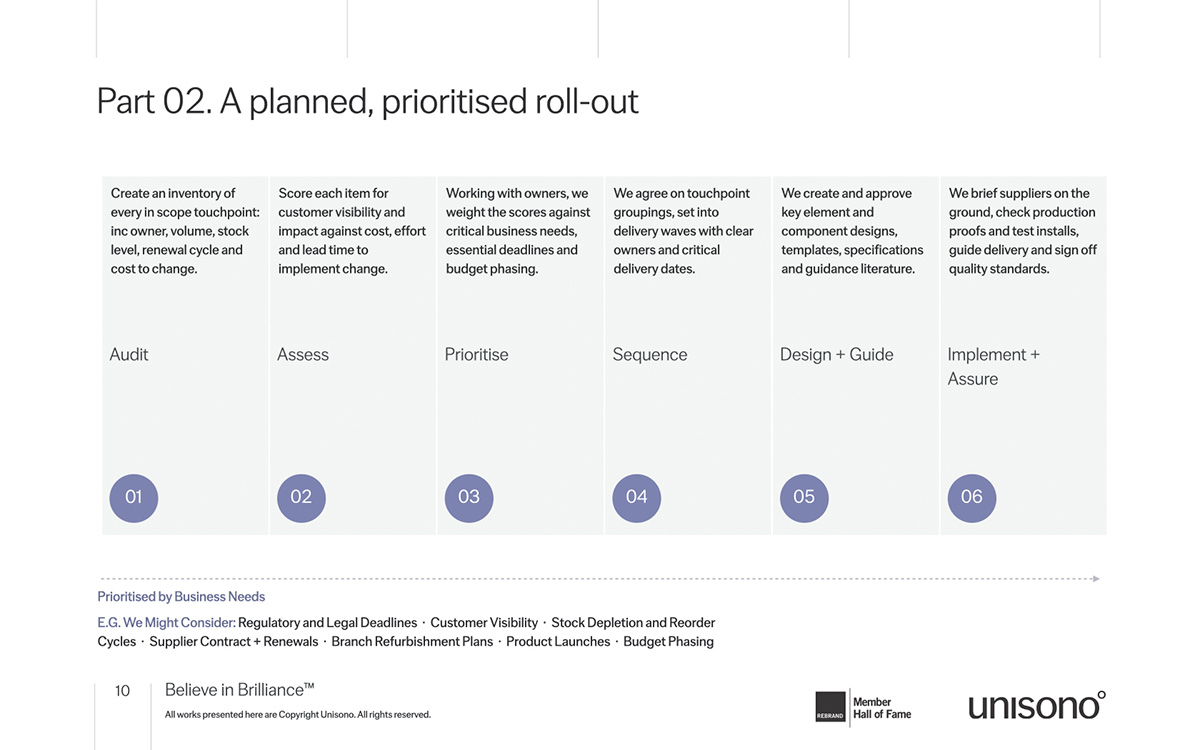
With your stakeholders aligned to the task ahead, they will let you know their units critical needs, so you can phase the work and ensure the ‘impactful essentials’ are done first and the nice-to-haves are covered off too.
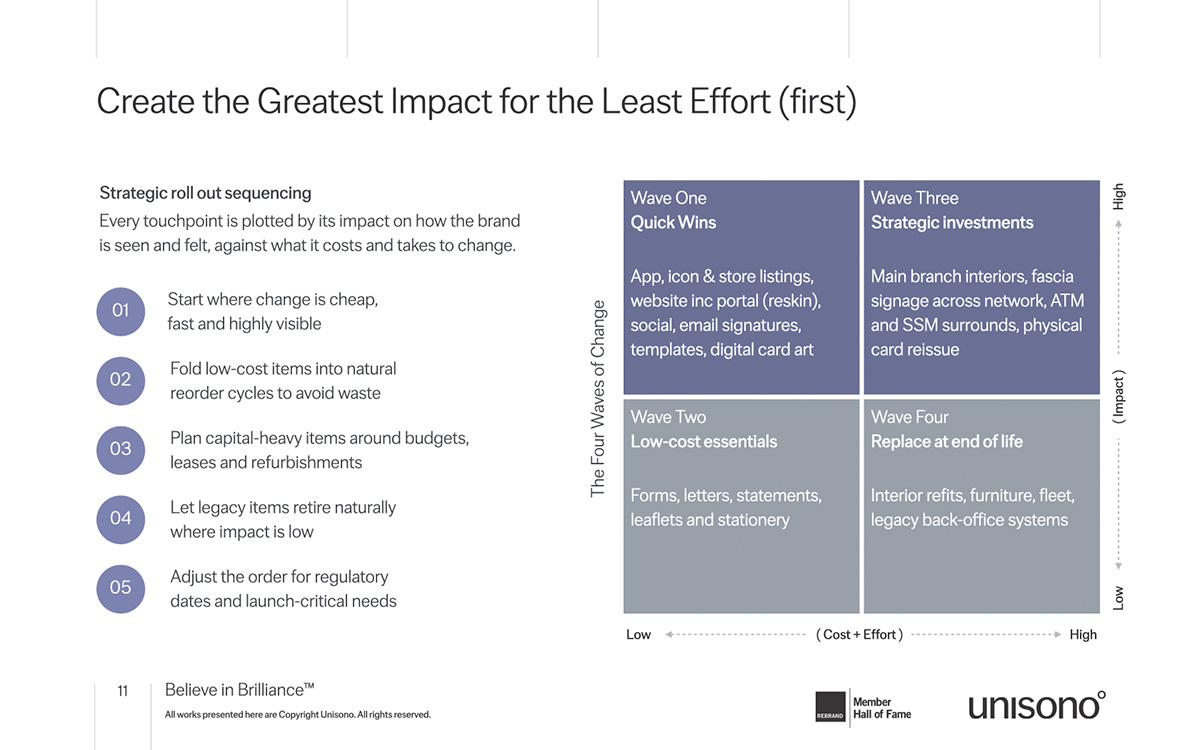
The implementation matrix helps you to place touchpoints in their relevant quadrant so the teams can work through them in order of effort and impact. What ever touchpoint provides the greatest impact for the least effort is always done first.
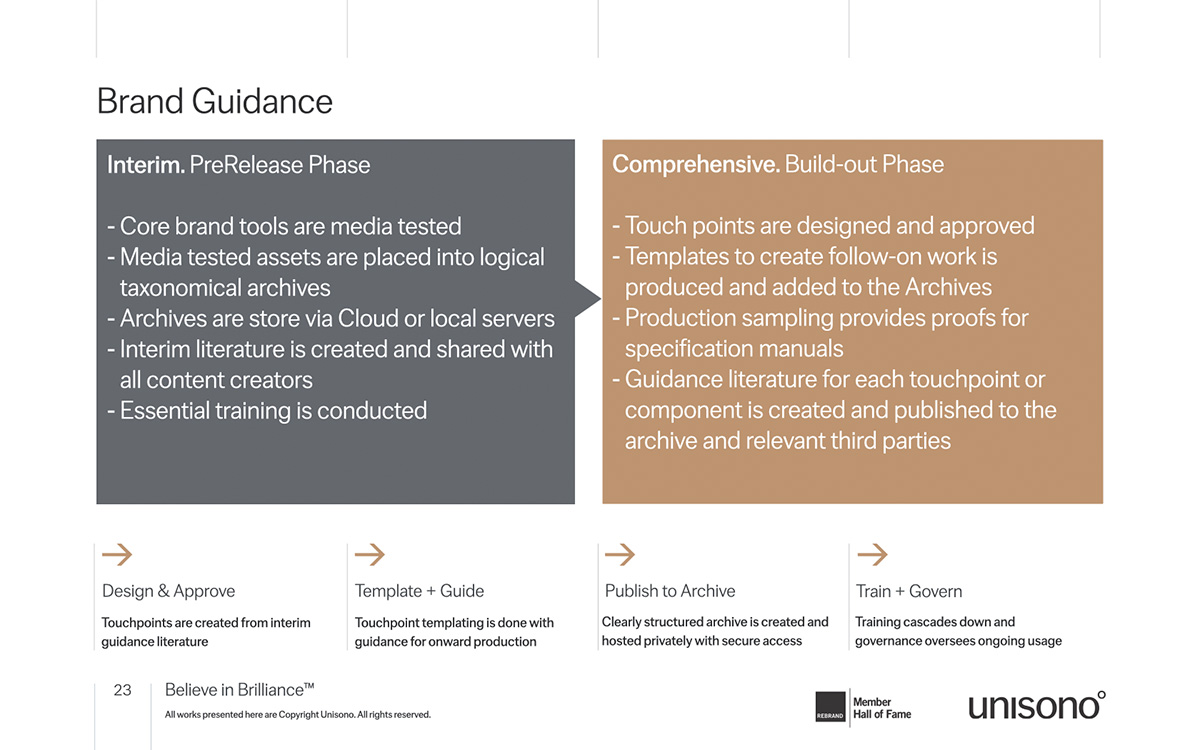
The creation of the comprehensive brand guidance literature ensures all stakeholders are aligned to the core purpose and expression of the brand. We start with the interim guidance focussing on the brand took kit before we create all the primary visual assets – these provide the required guidance for all secondary asset creation.
Bank brand implementation in practice: our financial sector work
The projects below show the full arc of bank brand implementation, from positioning and identity through to digital platforms, launch books and the annual reporting that keeps a brand consistent year after year.
- Khaleeji. Rebrand (Islamic bank, Bahrain) – A bold, ambition-focussed brand strategy and identity for one of Bahrain’s most ambitious banks
- Khaleeji. Digital (Islamic bank, Bahrain) – Carrying the new brand into a complete digital experience for a refocused audience
- Khaleeji. Brand Book (Islamic bank, Bahrain) – A launch book that cemented internal understanding of the new brand
- Bank Muscat. Rebrand (Retail and corporate bank, Oman) – An iconic rebrand helping a regional leader grow beyond traditional banking
- GFH. Rebrand (Investment banking group, Bahrain) – Rebranding one of the region’s most acclaimed investment banking groups
- GFH. Annual Report 2025 (Investment banking group, Bahrain) – Long-term brand stewardship through annual reporting and shareholder communication
- Mala’a. Rebrand (Credit bureau of the Central Bank of Oman) – A regulator-adjacent brand built for trust and data authority
- Esterad. Rebrand (Investment company, Bahrain) – A brand rooted in transformative regional investment
Our work has earned 157 international awards, Rebrand Hall of Fame membership and, in 2024, ten of the Rebrand 100 awards including Best of Show. Awards are a proxy for craft. The projects above are the proof of delivery. See the full portfolio or read about our process.
Common questions
What is a bank brand implementation exactly?
It is the planned rollout of a new or revised bank brand across every customer and employee touchpoint: branches, signage, digital channels, cards, ATMs, documents, uniforms, internal communications and supplier-produced materials. It is sequenced to fit regulatory approvals, budget cycles and business milestones.
How long does a bank rebrand rollout take?
For a licensed retail bank in the GCC, typically nine to eighteen months from strategy to full rollout. Strategy and identity usually take three to five months. The remainder depends on the size of the branch estate, digital release cycles, card reissue schedules and approval chains.
What is the most common reason a bank rebrand rollout fails?
Poor stakeholder alignment, closely followed by unrealistic timing. When staff, suppliers and business units are not briefed and committed, the brand customers experience drifts away from the brand the board approved.
Who should own the rollout inside the bank?
A named brand owner with board-level sponsorship, usually the head of marketing or corporate communications, supported by a cross-functional steering group (IT, operations, HR, compliance and facilities) and an agency that carries much of the coordination load.
How do I find the best agency for bank brands in the GCC and MENA?
Look for evidence of implementation, not just design: banking brands the agency has rolled out across branches, digital and print, experience with central bank and Sharia approval, Arabic treated as a design discipline and a senior team based in the region. Our buyer’s guide and checklist covers the selection process in detail.
___
Planning a brand transformation for your bank?
Unisono is a strategic branding agency headquartered in Manama, Bahrain, working with banks and financial institutions across the GCC, wider MENA and the UK. If you are looking for the best agency for bank brands to plan and deliver your rollout, start with our work on Khaleeji, Bank Muscat and GFH, browse the portfolio or email us (or call +973 1755 8787) for a conversation about your brief… before it becomes an RFP.
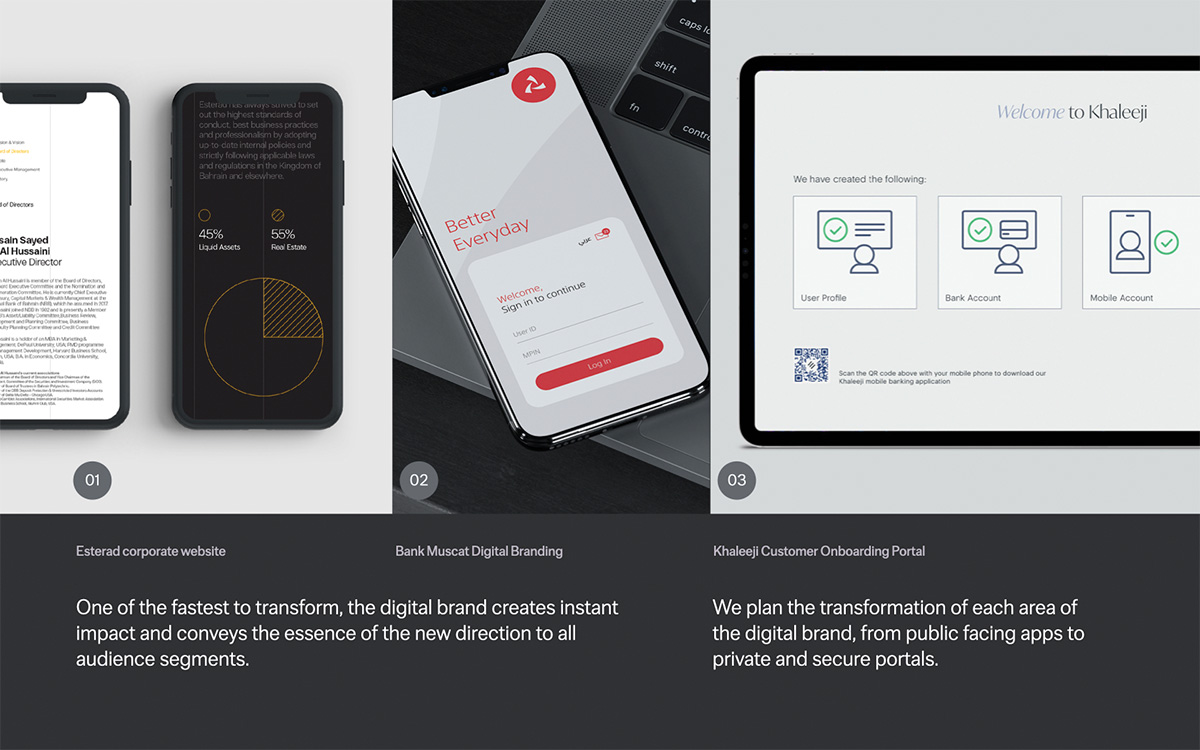
The most impact with the least effort starts with your digital brand. Get the icon and app store make over done and then set to on the digital reskin. Have it ready for the first day of launch to create maximum pop.
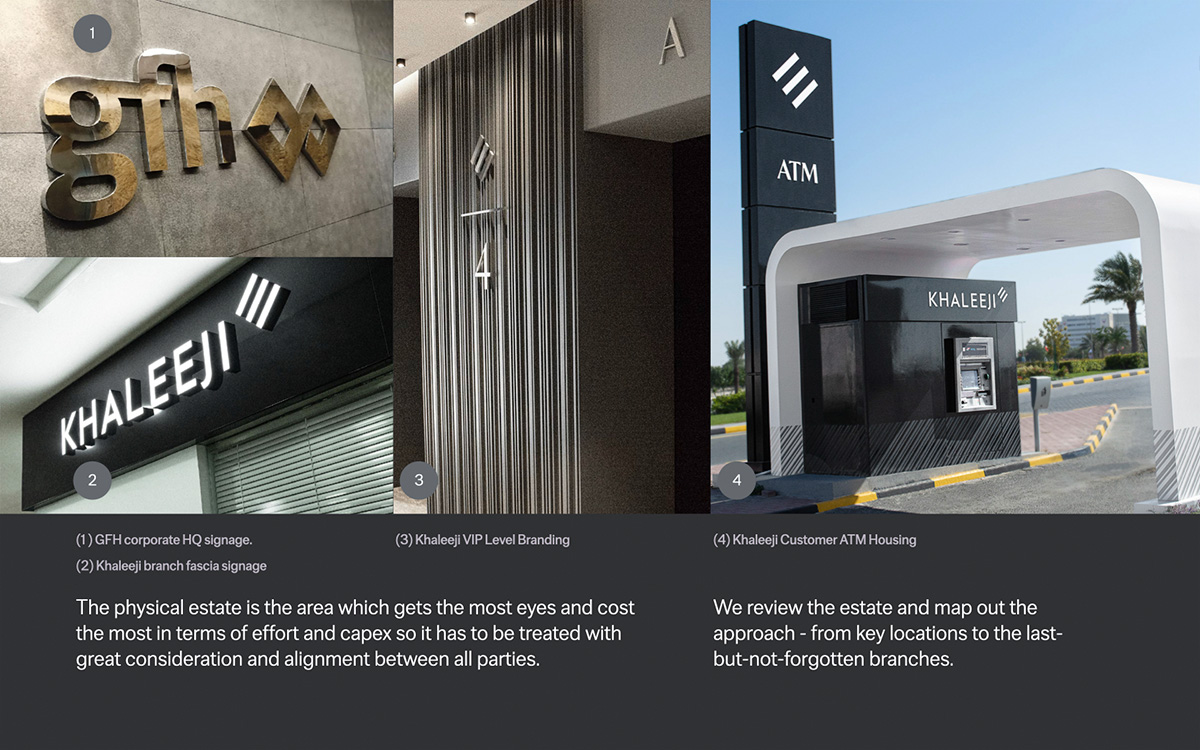
The visible estate has the longest lead time but creates the most impact. Plan it well and be ready to reveal the new brand on the HQ and most prominent outlets from day one.
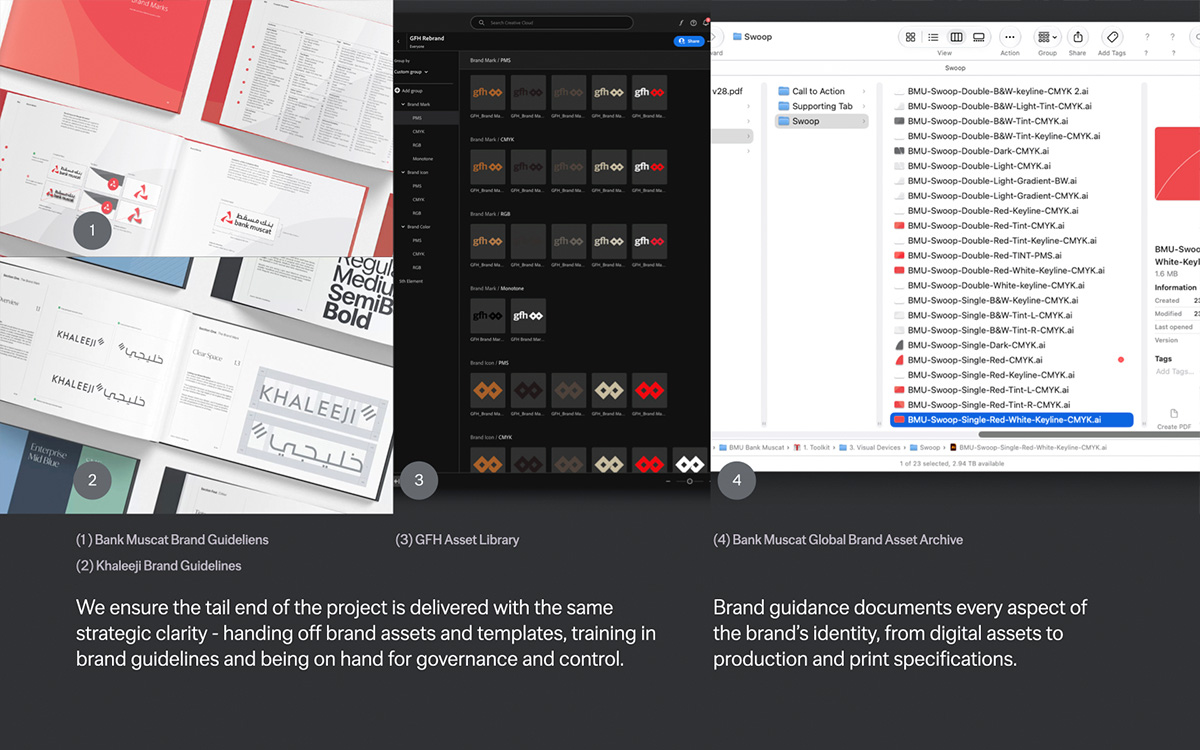
Ensure all your visual and literal assets are distributed to all your internal and external agencies. They will need training and guidance to get it right in the brand new world they will now occupy.
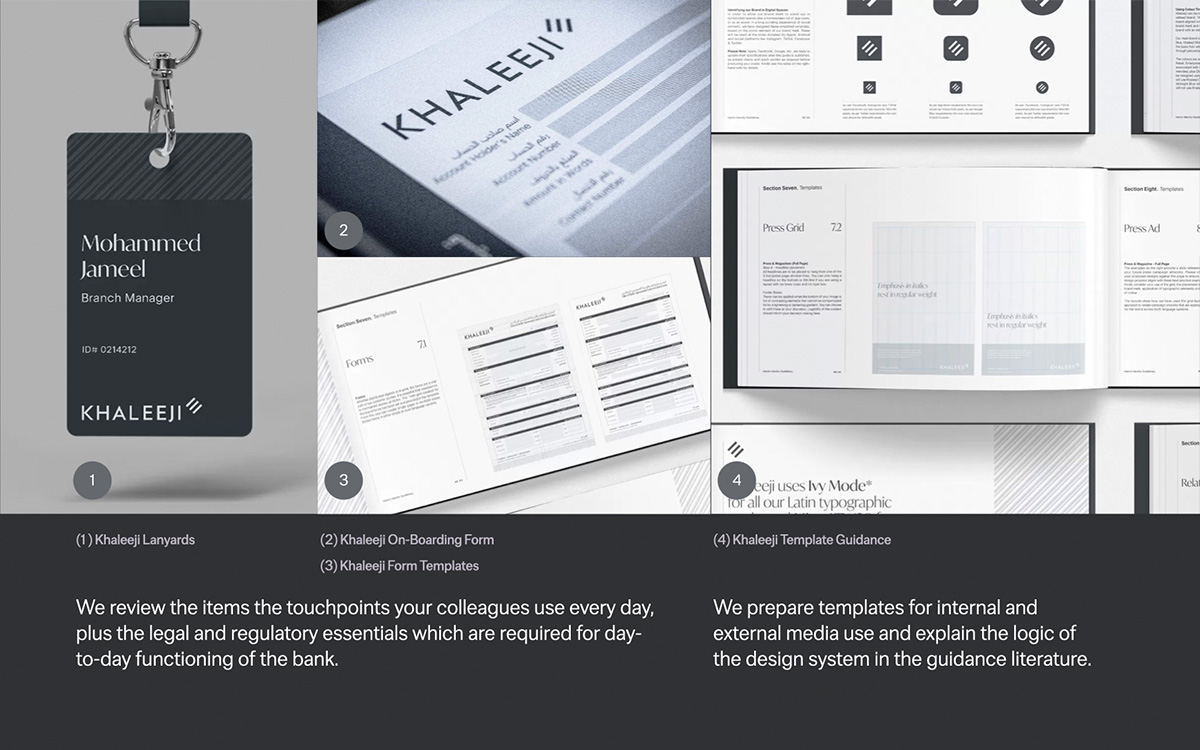
The long tail is where the final details come into focus. These matter as everyone plays a part in the symphonic whole – drop the ball here and the hard work of your amazing launch can be undone as you watch your audience’s belief in your brand slide right out the front door.
The best way to predict the future is to invent it.